The science behind MicroSigns.
150 years of decoding emotions
MicroSigns helps learners recognize facial movements faster, more accurately, allowing them to gain key insights into their counterparts & their emotions.




What MicroSigns Trains
- ✓
Facial movement recognition
- ✓
Faster visual attention
- ✓
Emotion pattern discrimination
- ✓
Learning through immediate feedback
What we don't claim
- ×
It does not read minds or hidden truth
- ×
It does not detect lies
- ×
It does not diagnose psychological states
- ×
It does not replace context or human judgment
Why this matters
Most people look at faces every day, but few are trained to observe them with discipline.
MicroSigns turns facial expression recognition into a repeatable training process: fast exposure, forced choice, immediate feedback, and adaptive repetition.
The Historical Foundation
More than a century of research into observable facial movement and emotions.
Charles Darwin
Proposed that some expressive behaviors are evolved patterns rooted in biology, opening the question of universality.
Carl-Herman Hjortsjö
Approached the face as a mimic language, where individual muscle movements act as "letters" forming expressions.
FACS Creation
Ekman & Friesen published the Facial Action Coding System, giving researchers a disciplined way to describe movement before interpretation.
Basic Emotions
Ekman formalized the argument that some emotions have distinctive, rapid, and recognizable expression patterns across cultures.
FACS Revision
The Facial Action Coding System was revised and expanded for more precise research and training use.
Training Evidence
Matsumoto & Hwang found evidence that adults can improve their ability to recognize micro-expressions through structured training.
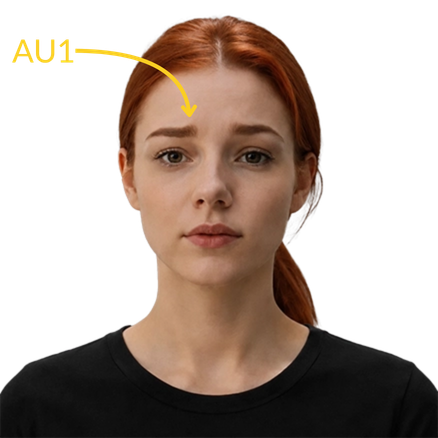
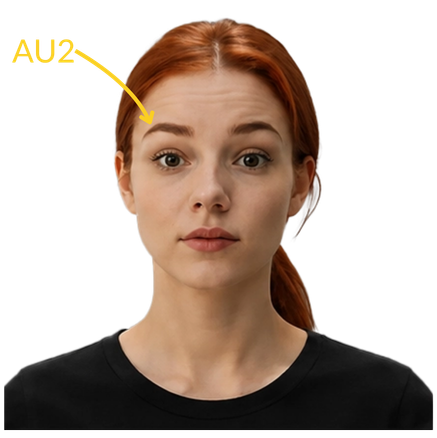
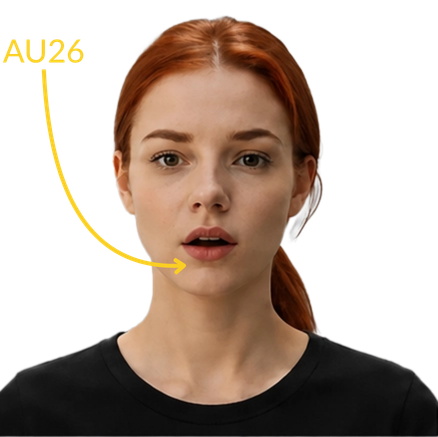
FACS helps describe facial movements.
Instead of saying "this person looks surprised", the Facial Action Coding System provides a shared vocabulary for observing the face before jumping to conclusions.
Each visible facial movement is coded as an Action Unit (AU). MicroSigns relies on this anatomical breakdown to build its training.


The Training Protocol
A face is never a perfect diagram. Training must expose learners to variation.
01. Speed
Facial expressions often appear quickly. Micro-expressions can last less than half a second. Training helps learners process these rapid cues under time pressure without freezing.
02. Accuracy
The goal is not to guess randomly. Accuracy is built through structured repetition and immediate visual feedback, turning conscious observation into unconscious reflex.
03. Discrimination
Fear and surprise can look similar. Disgust and contempt overlap. Anger and sadness share brow tension. We train you to notice the specific nuances that separate them.
How training becomes learning
Stimulus
You see a brief facial expression.
Choice
You make a forced-choice decision.
Feedback
You receive immediate correction.
Tracking
The system analyzes your confusions.
Focus Mode
Adaptive drills target your weak spots.
Ready to test your eye?
Start a free training sessionThe limit is part of the method.
Facial expressions are strong signals, not definitive proof.
They should be read carefully, in context, and never used alone for high-stakes judgments about truth, guilt, or intent. The face cannot tell us the whole story.
MicroSigns does not teach certainty.
It teaches disciplined observation.
Explore the methodology
Selected Bibliography
Darwin, C. (1872). The Expression of the Emotions in Man and Animals.
Hjortsjö, C.-H. (1969/1970). Man’s Face and Mimic Language.
Ekman, P., & Friesen, W. V. (1975). UNMASKING THE FACE : A guide to recognizing emotions from facial clues.
Ekman, P., & Friesen, W. V. (1978). Facial Action Coding System.
Ekman, P. (1992). “An Argument for Basic Emotions.”
Sayette, M. A. et al. (2001). A Psychometric Evaluation of FACS for Assessing Spontaneous Expression.
Matsumoto, D., & Hwang, H. S. (2011). Evidence for training the ability to read microexpressions of emotion.